Preparing for Life in a Group Home: Overnight Stays, Seizures, and Meals
In my previous post, I wrote about looking for a group home for Tonton while receiving support from visiting care workers.
This time, I want to record the small steps we are taking toward a future move, and the things that are on my mind.
Tonton is 19, but her experience of staying away from her parents has been limited to a few days on overnight school trips and hospital admissions because of seizures.
We were advised that, before moving into a group home, she would first need to get used to overnight stays through short-term respite care at a disability support facility.
So we began with temporary daytime care at a nearby day support facility. She attended seven or eight times over two months to get used to the place and the staff, before trying two separate one-night stays at the same facility.
In addition, she has had trial respite stays at the group homes I mentioned in my previous post.
“Everyone Was Kind”
Tonton seems to enjoy staying overnight away from home.
When I ask, “Would you like to try an overnight stay?” she nods. Afterward, when I ask, “Would you like to stay here again?” she nods too.
“Everyone was kind.”
Sometimes she tells me that as well.
Perhaps she is giving me the answer she thinks I want to hear. That possibility is also in the back of my mind.
Even so, I feel that the staff are treating her with care. We are building up these experiences little by little, paying attention both to what Tonton says and to how she seems.
Having Someone Who Can Respond to a Seizure
When looking for a group home for Tonton, who has Dravet syndrome, what matters most to me is whether the staff can respond to her seizures, including administering her rescue medication.
At first, I looked for group homes with nurses on site that could provide medical care.
But there were very few such homes, and the search was difficult.
When I broadened the search to include homes where care staff were willing to take on seizure response, possibilities gradually began to emerge.
Was there anything I could prepare to help a home consider welcoming her? One of the things I arranged with that in mind was an Apple Watch and an app called EpiCentr.
I hoped they could provide additional help in noticing seizures while she sleeps at night.
There were several devices overseas intended for seizure detection, but in my own search, I struggled to find options that we could obtain and use in Japan. One option I did find was using this app together with an Apple Watch.
This alone does not mean that all our preparations for seizures are in place. I see it as one part of getting ready to discuss her care with potential homes.
Alongside responding when a seizure happens, I also feel it is important to take steps to reduce potential triggers as much as possible.
For Tonton, we need to be mindful of her body temperature rising and of heat building up. I have therefore also explained to the staff the importance of adjusting the room temperature so that she can stay comfortable without getting too hot.
“Hot.” “Cold.” “Just right.”
We have prepared cards to help her express how she feels. As well as relying on those around her to notice how she is doing, I hope we can gradually practice ways for Tonton to tell them herself.
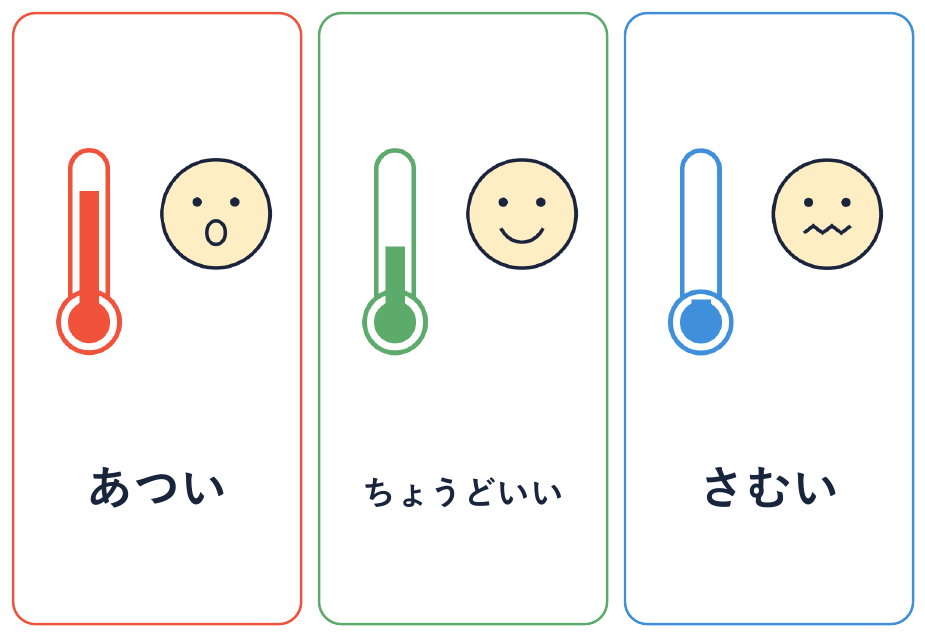
English meanings of the cards
Hot · Just right · Cold
Another Concern: Meals
Alongside seizure care, another thing on my mind as we prepare for life in a group home is food.
Tonton has always had strong food preferences and a small appetite. She takes Fintepla and Topina (topiramate), and I am also concerned about the medicines’ effects on her appetite.
Will she be able to eat enough in a group home where meals follow a set menu? Will she get the nutrition she needs and maintain her weight? These are worries I have.
For example, Tonton does not like curry rice. When it is served for lunch at her day support facility, she sometimes eats only “two bites.”
On days like that, we stop at a convenience store on the way home to buy something she likes, which she eats on the journey. Once home, I also ask her what she would like to eat and make it for her.
At home, I can make up for what she has missed in this way, depending on how much she has eaten that day.
But what will happen in a group home?
For her trial stays, I left some foods she might like with the staff—natto, tofu, croissants, and snacks—to offer before bedtime in case she had not eaten enough at mealtimes.
In the feedback afterward, I heard that she had been able to eat some of these foods on some occasions. At other times, the staff told me it had been difficult to respond because Tonton had not indicated what she wanted.
As well as preparing foods she likes, we need a way for her to communicate that she wants to eat them. I realized that this, too, was something we could prepare for.
Helping Her Express Herself: What We Can Do Now
After hearing from the staff, I made communication cards that I hoped would help Tonton express what she wants.
We have now started practicing using them at home, in preparation for a future move.
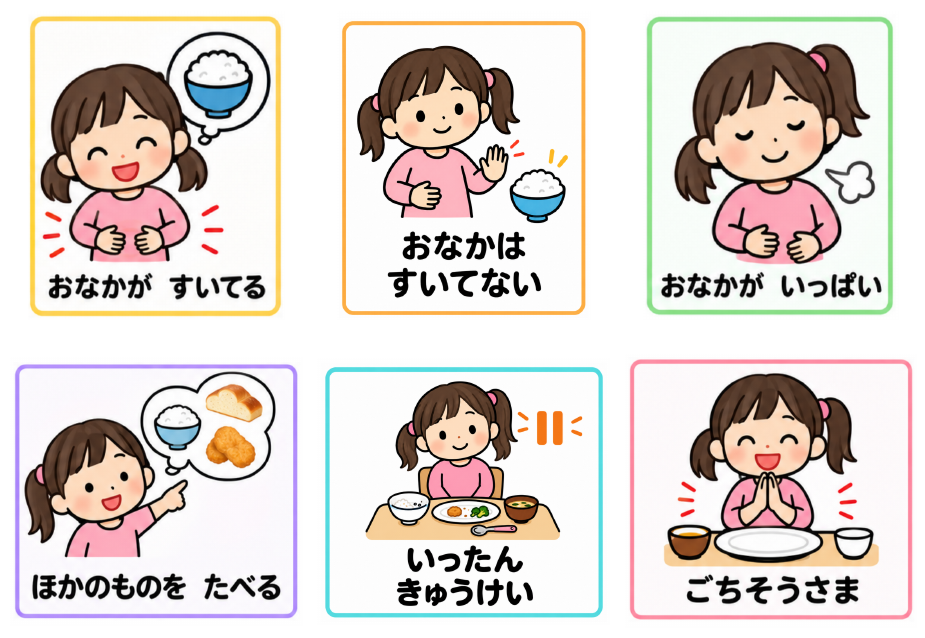
English meanings of the cards
I am hungry · I am not hungry · I am full · I want something else to eat · I need a break · I have finished eating
At home, there are things I ask her about, or work out from the way she usually behaves. When she lives away from her parents, I think it could help to have ways for her to communicate those feelings to other people too.
Sharing What a Parent Knows with the Staff
Another thing I prepared as her parent was what I call “Tonton’s manual.”
I put together a support guide describing her daily routines, the things she likes, ways of speaking to her, and situations in which she needs help, and shared it with the staff.
For example, when she finds it difficult to answer in words, showing her real objects or picture cards so she can choose by pointing. Preparing her clothes the right way around before handing them to her. Knowing that a favorite game or video can help her change her mood.
Each may seem like a small thing. But there are things that a parent living with her knows, which someone meeting her for the first time will not know unless we explain them.
I also wanted them to know that what she can do, and the pace at which she does it, can vary with her health and mood on the day.
It may be difficult for a group home to do everything exactly as we do at home. Still, I want to pass on what we have learned through our life together, as a starting point for getting to know Tonton.
As we learn from what the staff notice during her trial stays, I hope we can keep adapting both the cards and the guide to fit her future life.
Getting used to overnight stays. Having people who can respond when she has a seizure. Being able to eat and to express how she feels.
As we look for a group home, I have begun thinking more concretely not only about finding a vacancy, but about what everyday life there would be like for Tonton.
There are still things I do not know, and things I worry about. But there are also things we have learned and begun preparing for precisely because we tried these stays.
Holding on to Tonton’s words, “Everyone was kind,” I want to keep taking the steps we can toward her future life, one at a time.