On this blog, I call my daughter “Tonton.” It is a nickname inspired by the gentle pats she gives my back when I cough or choke on a drink. In Japanese, “ton-ton” describes that soft tapping sound.
Tonton loves singing. She enjoys karaoke and dances in her own way.
She also likes games, anime, Disney, and K-pop idols.
She enjoys spending time with animals, and she likes visiting zoos, aquariums, and amusement parks.
The Kindness She Shows Her Family
There are moments when I am reminded of Tonton’s kindness. When I cough or choke on a drink, she gently pats my back.
Once, one of my eyes was bloodshot. The next morning, Tonton got up on her own and asked me:
“Is your eye okay?”
Tonton usually finds it very hard to wake up. Yet she remembered what had happened the day before and asked how I was that morning. That moment has stayed with me.
This caring side is part of who Tonton is. I hope the people who will be involved in her life get to know it, too.
Living with Dravet Syndrome
Tonton has Dravet syndrome. For many years, I have struggled to keep her seizures under control.
Alongside being prepared for seizures, she needs support with many parts of daily life, including taking medication and bathing. As we consider her future home, overnight monitoring and the ability to respond to seizures are essential.
I hope those thinking about her support will also get to know the Tonton who enjoys singing and games, and who shows such kindness to her family.
Why I Am Looking for a New Home for My 19-Year-Old Daughter
Tonton is now 19.
The truth is, I still want us to live together for a long, long time.
That is how I feel as her father.
Because of our family circumstances, I chose to live with Tonton, just the two of us, and to take on her day-to-day care on my own.
On weekdays, Tonton attends a daytime support service for people with disabilities in Japan. I am a company employee. When we first began living together, I used paid leave and reduced working hours to try to balance my job with caring for her.
But I used up my paid leave, and that arrangement was no longer sustainable. I reached my limit and took a leave of absence from work.
My wish to keep living with Tonton has not changed. At the same time, the reality is that I could no longer sustain our daily life without stepping away from work.
That is why, now that Tonton is 19, I have had to begin seriously considering a group home—a shared home with support for people with disabilities.
I am seeking advice while holding both of these things in my heart: the wish to stay together, and the need to find a home that makes our life sustainable.
Gradually Returning to Work with Support at Home
Finding a group home takes time. So our plan is to begin using in-home disability support, gradually return to work, and eventually work toward a move to a group home.
Support workers have now begun visiting our home.
A Home Where She Can Keep Enjoying What She Loves
I want to find a place where Tonton can receive the support she needs, enjoy the things she loves, and feel safe.
To that end, I am exploring how group-home staff, support workers, visiting nurses, her doctor, a disability support coordinator, and the local ward office’s caseworker can work together. I also think it is important for her to become familiar with the place and the people gradually, through visits and trial stays.
We have not yet decided on a home or a support arrangement. There is still a great deal to check.
What I Hope to Share
In future posts, I hope to write about Tonton’s earlier years and our life since it became just the two of us.
I also plan to share what we have experienced and the barriers we have encountered while looking into support and seeking advice. In Japan, this includes assessments of disability support needs, brief care and overnight respite services, visiting nursing, support for getting out and about, intensive home support, other in-home services, and group homes.
I would also like to write about applying for Japan’s disability pension and moving from the medical-expense subsidy system for children with specified chronic illnesses to the system for designated intractable diseases.
Since Tonton graduated from a special needs school at 18, disability services and paperwork associated with the transition to adulthood have come at us in a rush. This blog will be my personal record of what I have researched, the advice I have sought, what has worked, and what has been difficult.
I hope our efforts to find a way forward for Tonton’s life may offer something useful to other families looking for a home for someone they love.
At around half past three in the afternoon, I drive to pick Tonton up from the daytime disability support service she attends.
Once we get home, I first give her something to eat. Then I ask,
“Would you like to play something?”
These days, she answers, “Karaoke.”
We use karaoke on the Nintendo Switch. I bring up the screen showing the songs we have sung before and ask,
“What would you like to sing?”
That is how we choose.
Her recent favorites are Disney songs: “Love Is an Open Door,” “A Whole New World,” and “Beauty and the Beast.” She chooses duets, so I sing with her.
When the intro starts, Tonton asks me,
“Which of us starts again?”
When the male part comes around, she hands me the microphone. And as we sing together, she looks at my face while singing the final lines of the chorus.
I get a little shy, too.
But in those moments, I find myself thinking,
“I wish this moment could last forever.”
In my previous post, I wrote about why I am looking for a future home for her. There is a lot we need to think about, but our days together also hold moments like these.
Coming home, having something to eat, and singing together.
For me, it is an ordinary yet irreplaceable moment of happiness in everyday life.
Before Support at Home Began: Finding Our Way Through Three Options
In an earlier post, I wrote that we had begun using in-home disability support, with a plan for me to gradually return to work while looking for a group home for Tonton.
This time, I want to record how we arrived at that plan.
My job involves frequent business trips.
I felt that returning to work without restrictions would require either a place in a group home or arrangements for someone to watch over Tonton at home, 24 hours a day, every day of the year.
My first hope was for her to keep living at home.
Our First Choice: Staying in Her Own Home
The service I hoped we might be able to use was Japan’s intensive home-visit care program for people with severe disabilities, known as judo homon kaigo.
It would mean less change in Tonton’s surroundings and allow her to stay in the home she knew. That was why it was my first choice.
But the caseworker in our local government’s disability welfare section explained that Tonton was not eligible because her current score on the behavior-related assessment items was 3.
Our disability support coordinator’s assessment was also:
“Three is certainly too low, but I don’t think she would reach ten.”
Ten was the score we were told at the time that Tonton would need in order to access this service.
As her parent, I wondered whether there was some way to make it possible. I sought advice from various people and considered requesting a reassessment.
At first, I felt ready to fight the authorities if that was what it took.
But these were also the people I would need to keep consulting about her support for years to come. I worried that the way I pursued the issue might make my relationship with the caseworker more difficult.
It was not that our relationship had actually deteriorated. Still, after thinking it over from different angles, I decided to stop pursuing this service.
It had been the option I most wanted to use so that she could remain at home. Now I had to consider another path.
A Group Home Was Not Easy to Find Either
Our second option was a group home—a shared home with support for people with disabilities.
At that point, however, Tonton had experienced only one short-term overnight respite stay.
And none of the nearby homes that seemed potentially able to support her with Dravet syndrome had a vacancy.
A place that could provide the support she needed. Somewhere she could gradually get used to the people and surroundings. And an available place.
It did not look as though we would find all of that easily.
Our Third Path: Bringing Support into Our Home
So we chose to make as much use as possible of visiting support workers through Japan’s in-home disability care service, known as kyotaku kaigo.
Even if I could not return to work fully, I would start by returning with restrictions. We would keep living that way while continuing our search for a group home.
That became our third option.
From discussing this plan with our disability support coordinator to finding support workers and reaching the first day of support, it took about two months.
We are starting with two visits a week, with a plan to increase to five days a week at a pace that allows Tonton to get used to it.
Having support begin does not mean that everything falls into place straight away. But we have taken a first step toward getting help with life at home.
Doing What We Can, One Step at a Time
Throughout this time, we have also continued looking for a group home.
We have been taking the steps available to us, including trial respite stays at places where openings happened to come up—one about a 30-minute drive away, and another about two hours away.
What on earth will happen from here?
Sometimes I think I have not felt this uncertain about the future since the period I spent studying to retake my university entrance exams.
This time, though, there are things that my own efforts alone cannot change. At times, that leaves me feeling helpless.
Even so, I want to do whatever I can.
After the trial stays, I wrote letters to the group homes that had welcomed Tonton, to thank them.
Is there anything else I can do?
That is a question I keep asking myself as I work through what is in front of us, one step at a time.
This post records the explanations our family received and our experiences at the time. Eligibility for services such as intensive home-visit care is not determined universally by the scores described here alone. These are Japanese support services; please check eligibility and procedures with your local government or support coordinator.
Preparing for Life in a Group Home: Overnight Stays, Seizures, and Meals
In my previous post, I wrote about looking for a group home for Tonton while receiving support from visiting care workers.
This time, I want to record the small steps we are taking toward a future move, and the things that are on my mind.
Tonton is 19, but her experience of staying away from her parents has been limited to a few days on overnight school trips and hospital admissions because of seizures.
We were advised that, before moving into a group home, she would first need to get used to overnight stays through short-term respite care at a disability support facility.
So we began with temporary daytime care at a nearby day support facility. She attended seven or eight times over two months to get used to the place and the staff, before trying two separate one-night stays at the same facility.
In addition, she has had trial respite stays at the group homes I mentioned in my previous post.
“Everyone Was Kind”
Tonton seems to enjoy staying overnight away from home.
When I ask, “Would you like to try an overnight stay?” she nods. Afterward, when I ask, “Would you like to stay here again?” she nods too.
“Everyone was kind.”
Sometimes she tells me that as well.
Perhaps she is giving me the answer she thinks I want to hear. That possibility is also in the back of my mind.
Even so, I feel that the staff are treating her with care. We are building up these experiences little by little, paying attention both to what Tonton says and to how she seems.
Having Someone Who Can Respond to a Seizure
When looking for a group home for Tonton, who has Dravet syndrome, what matters most to me is whether the staff can respond to her seizures, including administering her rescue medication.
At first, I looked for group homes with nurses on site that could provide medical care.
But there were very few such homes, and the search was difficult.
When I broadened the search to include homes where care staff were willing to take on seizure response, possibilities gradually began to emerge.
Was there anything I could prepare to help a home consider welcoming her? One of the things I arranged with that in mind was an Apple Watch and an app called EpiCentr.
I hoped they could provide additional help in noticing seizures while she sleeps at night.
There were several devices overseas intended for seizure detection, but in my own search, I struggled to find options that we could obtain and use in Japan. One option I did find was using this app together with an Apple Watch.
This alone does not mean that all our preparations for seizures are in place. I see it as one part of getting ready to discuss her care with potential homes.
Alongside responding when a seizure happens, I also feel it is important to take steps to reduce potential triggers as much as possible.
For Tonton, we need to be mindful of her body temperature rising and of heat building up. I have therefore also explained to the staff the importance of adjusting the room temperature so that she can stay comfortable without getting too hot.
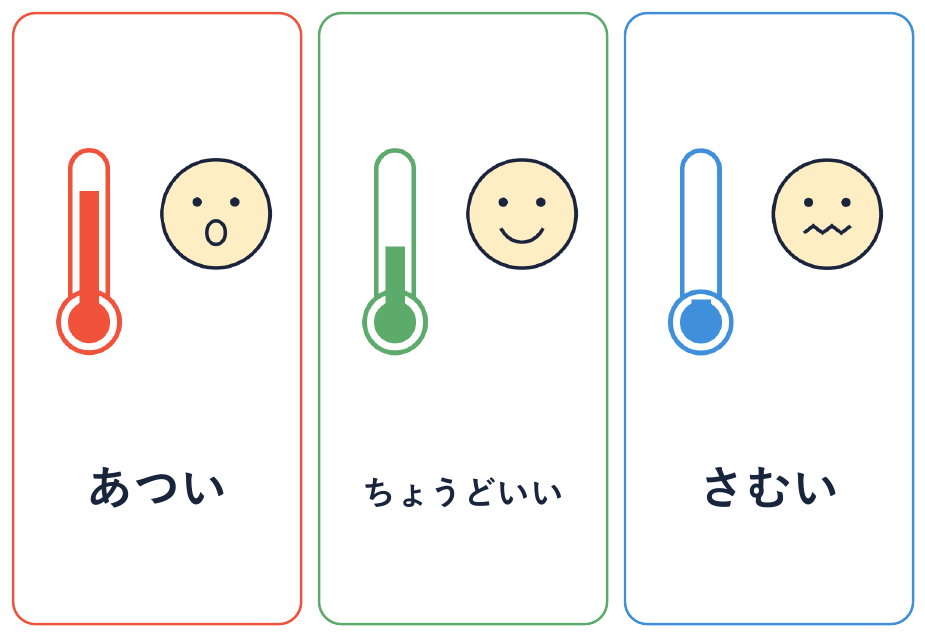
“Hot.” “Cold.” “Just right.”
We have prepared cards to help her express how she feels. As well as relying on those around her to notice how she is doing, I hope we can gradually practice ways for Tonton to tell them herself.
Cards to help her express whether she feels hot, comfortable, or cold. The original cards are in Japanese.English meanings of the cards
Hot · Just right · Cold
Another Concern: Meals
Alongside seizure care, another thing on my mind as we prepare for life in a group home is food.
Tonton has always had strong food preferences and a small appetite. She takes Fintepla and Topina (topiramate), and I am also concerned about the medicines’ effects on her appetite.
Will she be able to eat enough in a group home where meals follow a set menu? Will she get the nutrition she needs and maintain her weight? These are worries I have.
For example, Tonton does not like curry rice. When it is served for lunch at her day support facility, she sometimes eats only “two bites.”
On days like that, we stop at a convenience store on the way home to buy something she likes, which she eats on the journey. Once home, I also ask her what she would like to eat and make it for her.
At home, I can make up for what she has missed in this way, depending on how much she has eaten that day.
But what will happen in a group home?
For her trial stays, I left some foods she might like with the staff—natto, tofu, croissants, and snacks—to offer before bedtime in case she had not eaten enough at mealtimes.
In the feedback afterward, I heard that she had been able to eat some of these foods on some occasions. At other times, the staff told me it had been difficult to respond because Tonton had not indicated what she wanted.
As well as preparing foods she likes, we need a way for her to communicate that she wants to eat them. I realized that this, too, was something we could prepare for.
Helping Her Express Herself: What We Can Do Now
After hearing from the staff, I made communication cards that I hoped would help Tonton express what she wants.
We have now started practicing using them at home, in preparation for a future move.
Cards to express how hungry she feels and whether she wants to continue eating. We are gradually practicing at home. The original cards are in Japanese.English meanings of the cards
I am hungry · I am not hungry · I am full · I want something else to eat · I need a break · I have finished eating
At home, there are things I ask her about, or work out from the way she usually behaves. When she lives away from her parents, I think it could help to have ways for her to communicate those feelings to other people too.
Sharing What a Parent Knows with the Staff
Another thing I prepared as her parent was what I call “Tonton’s manual.”
I put together a support guide describing her daily routines, the things she likes, ways of speaking to her, and situations in which she needs help, and shared it with the staff.
For example, when she finds it difficult to answer in words, showing her real objects or picture cards so she can choose by pointing. Preparing her clothes the right way around before handing them to her. Knowing that a favorite game or video can help her change her mood.
Each may seem like a small thing. But there are things that a parent living with her knows, which someone meeting her for the first time will not know unless we explain them.
I also wanted them to know that what she can do, and the pace at which she does it, can vary with her health and mood on the day.
It may be difficult for a group home to do everything exactly as we do at home. Still, I want to pass on what we have learned through our life together, as a starting point for getting to know Tonton.
As we learn from what the staff notice during her trial stays, I hope we can keep adapting both the cards and the guide to fit her future life.
Getting used to overnight stays. Having people who can respond when she has a seizure. Being able to eat and to express how she feels.
As we look for a group home, I have begun thinking more concretely not only about finding a vacancy, but about what everyday life there would be like for Tonton.
There are still things I do not know, and things I worry about. But there are also things we have learned and begun preparing for precisely because we tried these stays.
Holding on to Tonton’s words, “Everyone was kind,” I want to keep taking the steps we can toward her future life, one at a time.
I think it was the second day a care worker came to our home.
I was in the same house, but I spent about an hour in a different room from Tonton and the care worker.
I could not really make out what they were saying.
I could just hear Tonton talking about something with the care worker.
As I listened, I went about my own things.
Thinking back, it had taken about two months to reach this point.
As soon as Tonton and I began living together on our own, I started looking for home-help support. It took roughly two months before a care worker actually came to our house.
Tonton and I began living together on our own about two months ago.
The circumstances that led to this involve our family, so I have decided not to write about them in detail here.
But when I decided that the two of us would live together, my work immediately became a practical concern.
Tonton attends a day support service.
I can see her off in the morning and then go to work.
The problem comes afterward.
The time Tonton gets home does not match the time I can return from work.
There are meals, baths, and medication to think about, too.
My work also involved overnight business trips.
I could not manage our life together on my own while continuing to work as I had before.
The first person I spoke to was our support planning coordinator.
Alongside looking for a group home, I asked whether we could use a disability welfare service called home-help support, or kyotaku kaigo.
My initial thought was that if we could get support from as early in the morning as possible until nighttime, I might be able to retain some flexibility in my work.
But I was told that finding a care worker for the early morning hours would be difficult in practice.
In that case, I would see Tonton off to her day support service in the morning, then go to work.
A care worker would look after her once she returned home, and I would be back by around 9 p.m., when she goes to bed.
I would also ask my employer to adjust my working hours.
I thought that arrangement might make it possible to balance work with our life together.
But the question of overnight business trips remained.
So I also looked into another disability welfare service called intensive home-visit care, or judo homon kaigo.
Tonton could stay in our current home and continue attending her current day support service, while I could keep working in something close to the way I had before.
I hoped this service might make that possible.
I spoke with our support planning coordinator and the ward office staff, and contacted other support organizations as well.
However, I was told that Tonton did not meet the requirements needed to use this service.
Needing a great deal of support and meeting the eligibility requirements for a particular service are not the same thing.
That was something I came to understand at the time.
So home-help support was what we needed first.
Our support planning coordinator told me that a care worker might be able to start coming as early as mid-August.
I thought we might manage if that happened, and planned how to balance work and home on that assumption.
Until then, I managed by asking to be taken off overnight assignments and having my working hours adjusted.
Even so, on days when Tonton’s day support hours did not fit with work, I had no choice but to use paid leave.
There were days when family members could help, but that could not continue indefinitely.
Yet by mid-August, we still had not found a care worker.
Being approved for a certain number of support hours does not necessarily mean there is someone available to provide them.
There simply are not enough people.
It is hard to find a provider that can take you on.
Even when someone is available, their days or hours may not match what you need.
In Tonton’s case, we had also requested a female care worker to assist her with personal care.
And Tonton needs various kinds of support in daily life, including help with meals, bathing, medication, and responding to seizures.
It was not a matter of having just anyone come.
At one point, there was talk of combining several providers to cover five days a week.
As all this continued, I ran out of paid leave in August.
Work, Tonton, and other family matters.
Many things were happening at the same time, and by the end of August, it had become difficult to keep everything going while continuing to work.
It was after that that we heard a care worker might be available.
One provider seemed able to offer support five days a week, and we moved ahead with meetings and the contract.
The first care worker came to our home in mid-September.
Having a care worker start coming does not mean I can immediately work the way I used to.
Even so, I felt that the first step toward returning to work, even on a limited basis, had finally begun.
Including today, the care worker has visited four times. Each time, I have stayed home and been beside Tonton.
Preparing food.
Helping her eat.
Playing together.
Bathing.
Taking medication.
As I watched alongside them, I explained things one by one: “This is how we do it with Tonton.”
One thing has stayed with me.
Among the medicines Tonton takes every day, there is one whose prescribed amount needs to be measured out.
After preparing it, the care worker showed it to me and asked,
“Is this right?”
She checked with me before going ahead.
On another day, she used her smartphone to magnify the markings on the container, then showed me what she had prepared once more.
When giving the medicine proved difficult, she also asked whether it would be all right to try a different way.
I did not find these checks bothersome at all.
On the contrary, I felt reassured that she would ask about anything uncertain rather than leave it unresolved.
At mealtimes, too, she waits patiently and follows Tonton’s pace.
When Tonton seemed sleepy partway through a meal, I explained,
“At times like this, we sometimes have her take a bath first.”
Little by little, I found more things to share.
“If there are any places you would prefer us not to open, please let us know,”
she said, taking the initiative to check about things around the house as well.
It felt like a time for us to learn about Tonton together, rather than simply having someone provide support.
On her second visit, I spent about an hour in another room.
From there, I could hear Tonton talking.
To me, it seems that when Tonton feels someone is truly treating her kindly, she gradually opens up to them.
That day, too, she was chatting with the care worker quite naturally.
This is the moment I described at the beginning.
I was in another room, listening to her voice as I went about my own things.
The same care worker has come for all four visits so far.
For now, she is learning, one thing at a time, about Tonton’s meals, baths, medication, and how she usually spends her day.
Two other care workers are scheduled to start coming as well. For the handover, the person who has been coming so far will visit together with them.
When we were talking about that,
“We would like you to be home then, too. You would feel uneasy without meeting the care workers who will be coming, wouldn’t you?”
she said.
She was right.
These are people who will eventually spend time alone with Tonton.
I want to meet them at least once myself.
I was glad she had thought of that before I even said it.
The person who has been coming will get to know Tonton and then pass that knowledge on to the next people.
With that kind of handover, perhaps I can gradually leave things in their hands.
That was how I began to feel.
The plan is for three care workers to take turns, building up to support five days a week.
Starting by trusting one person, and gradually becoming able to entrust her care to several people.
That is the process we are in now.
And today, I asked the care worker,
“What should I do while you are here?”
Then,
“It is absolutely fine for you to stay. Providing care while family members are at home is quite normal with other families, too.”
she told me.
I had been thinking that perhaps I should eventually go out for a while, so Tonton and the care worker could spend time on their own.
But if I had no particular reason to go out, there was no need to force myself to leave.
I stayed home today, too.
I just kept a little more distance from Tonton than before and took care of some things of my own.
I did not keep going over to check whether everything was all right.
Tonton was calmly eating with the care worker.
Afterward, they played together.
She did not come to call for me. The two of them simply spent time together.
I have not returned to work yet.
The other two care workers still need to get to know Tonton.
Will support five days a week really come together and make it possible for me to return to work, even on a limited basis?
I still do not know.
Even so, until a little while ago, I was the only person looking after Tonton most of the time.
Now there is someone in the same house who waits patiently while Tonton eats.
Someone who checks with me when there is anything uncertain about her medication.
Someone who plays with Tonton.
While they do that, I can be a little farther away and attend to my own things.
I have not gone out of the house.
I have not returned to work, either.
That is all I managed to do today.
But as I saw the two of them spending time calmly together, I went about my own things without repeatedly going over to check.
Before I knew it, I was leaving her care in someone else’s hands.
For us, at this point in our lives, I think that is a change in itself.
It was the home where Tonton had spent three days and two nights on a trial stay.
Other people were also hoping to move in. The home had told me they would make a decision after everyone had completed their trial stays.
While I waited, the same thoughts kept coming back.
If she could move in, I would be happy.
But if she did, the life Tonton and I share now would change.
If she couldn't, what would we do next?
I felt that neither answer would be easy to take in.
I had first found this home while searching online.
Before that, I had mainly been looking for group homes with nurses on staff, but vacancies were hard to find.
Tonton had also had a trial stay at a home in another area.
The staff there were kind and took good care of her. But when I thought about whether she could keep attending her current day support service, and how they would respond if she had a seizure, living there seemed difficult.
That was when I found this home.
Their information mentioned accepting people with intractable diseases, and they had a vacancy at a location relatively close to our house.
I went to visit on my own first.
During the visit, a staff member noticed that the room was a little warm and adjusted the air conditioning straight away.
It may seem like a small thing.
But for Tonton, room temperature matters to her health.
I was glad they had noticed and responded without being asked.
There was also a staff member who knew about epilepsy, and we were able to talk about what to do if she had a seizure.
I thought, this might be the place.
After that, Tonton went for her three-day, two-night trial stay.
On the first evening, at around 8:30, the home called me.
They told me she had stopped responding as she had been earlier, and her gaze had become fixed.
They thought she might be having a seizure without convulsions. Following the written instructions I had given them beforehand, they had administered her rescue medication, Supizia.
Of course, hearing that she might have had a seizure worried me.
At the same time, I felt reassured that the staff had noticed the change in Tonton and had checked the instructions I had provided as they responded.
Early the next morning, I went to the home to drop off more medication.
A staff member said to me,
“She's still asleep, but would you like to see her before you go? You must be worried.”
I was grateful for those words, too.
I had planned only to hand over the medication and leave. But they had also thought about how worried I might be.
Through these exchanges, I found myself hoping more and more that Tonton could live at this home.
But when I picked her up at the end of the trial stay, the staff told me that at some meals she had eaten almost nothing. They said it had been difficult when she didn't respond to them as they spoke to her during meals.
Hearing that, I thought,
Oh. This probably isn't going to work out.
If the staff were struggling, they might tell me they couldn't accept her.
That was how I felt.
Then the home's manager, a man, showed me a photo on his smartphone.
Tonton was smiling as she spent time with the other residents.
He said that as she became more comfortable there, they might gradually be able to communicate with her more easily.
Seeing that photo brought back a little hope.
When we got home, I asked Tonton,
“How was it?”
She said,
“Everyone was kind.”
“Would you like to stay there again?”
When I asked, she nodded.
Then perhaps, if they could have a little more time to get to know her.
That was what I hoped as I waited for their answer.
Then, one day,
I noticed a missed call on my phone.
I had been in another room when it rang and hadn't been able to answer.
The call history showed it was from the group home.
I went to call back, then hesitated.
If I just waited, perhaps they would call again.
I hesitated for a while. But whatever the answer was, I couldn't move forward without hearing it.
I braced myself and called back.
“We can't offer her a place right away.”
That was the answer.
They went on to explain something about why another person had been offered the place, but I couldn't take in anything more.
What brought me back to the conversation was,
“We have a vacancy at a home in another city. Would you be interested?”
They then put me through to the person responsible for that area, who continued explaining about the home.
Still unable to shift my feelings, I murmured acknowledgments while searching desperately for the location on Google Maps.
More than an hour's drive from our house.
That's far, I thought.
They offered a date for a visit, and I booked it there and then.
After I hung up,
“Ah. So it didn't work out after all.”
The words came out before I could stop them.
But almost immediately, I began thinking about other things, too.
Could she get to her current day support service from there?
If she couldn't keep going, how would her daily life change?
Even so, if there were good people there, I might want to entrust her care to them.
One thought after another came into my mind.
And being offered another home meant that the company running the homes hadn't ruled out accepting Tonton altogether. I felt there was still a possibility.
That day was one of the two days a week when our home care worker came.
Tonton was spending the day at her usual day support service.
When the care worker arrived, I told her I had heard back from the group home.
“In that case, finding a group home looks as though it may take a little longer. Let's go ahead as planned and prepare for care visits every weekday from next month,” she said.
At present, she comes twice a week. From next month, we are planning to have care workers come five times a week.
She told me she had also spoken by phone with our support planning coordinator to prepare for that.
She shared something from their conversation.
“When I told the coordinator that Tonton helps me prepare dinner, they were surprised.”
Recently, Tonton has been standing beside the care worker in the kitchen, helping to prepare dinner.
Later, while the two of them were standing together in the kitchen, I called the support planning coordinator.
I had heard that support for attending her day service had also come up in their earlier conversation, and I wanted to hear more about it.
During our call, the coordinator brought up Tonton's helping to prepare dinner.
“When I heard that, I nearly cried,” they said.
I told them exactly what I had been feeling about our life now.
“The life we have now is wonderful in its own way. But to return fully to work, I need to find a group home. I don't really know what's best anymore.”
I'm not looking for a group home because I dislike our life now.
If anything, since the care worker started coming, new things have gradually become part of Tonton's life.
Even so, I have to return to work.
Wanting to keep living this way, and knowing how difficult that is, are feelings I carry together all the time.
Then the coordinator said,
“I still think intensive home-visit care would be the best option. I'd like to keep exploring whether we can find a way in that direction.”
I was a little surprised.
Intensive home-visit care was a service I had looked into myself when Tonton and I first started living together.
But I had been told that she didn't have the required assessment score and wasn't eligible.
The same coordinator who had told me then that it would be difficult was now saying they wanted to work toward that option.
“Is there a realistic chance of making it happen?”
I asked.
“It would require a change in the law,” the coordinator replied.
This wasn't a conversation about a service we would be able to use soon.
But they said that the service itself hadn't always existed, and expressed the hope that the need for it among people like Tonton could also be recognized.
At some point, that day's phone call had become a planning session about our future.
First, we would continue preparing, as planned, for care workers to come five times a week from next month.
In the meantime, we would keep looking for a group home.
And even if Tonton could move into one, we wouldn't stop there. We would keep exploring a path toward using intensive home-visit care, too.
By the time I hung up, I felt lighter. While on leave from work, I don't talk to many people, and being able to share all the feelings that had been weighing on me had helped clear my head.
I hadn't received the answer I had hoped for. But by the end of that day, I was able to think about what to do next.
Today, for the first time, Tonton called one of her support workers by name.
“It's Ms. ○○.”
She is the support worker who has been coming on Mondays and Fridays.
She had also come yesterday for an extra visit, and I noticed something different then.
She was wearing a name tag.
“Have you always worn a name tag?”
I asked.
“Today is the first time. I thought it might help her remember my name,”
she said with a smile.
And today, when she arrived, Tonton said her name for the very first time.
Today, our regular support worker brought another female support worker with her.
Starting next month, we plan to have a support worker come every weekday. The person who has been coming on Mondays and Fridays will continue on those days, and the new support worker will cover other days of the week.
To prepare for that, our regular support worker showed her new colleague how she helps Tonton, explaining the routine as they went along.
At one point, the two support workers and Tonton were sitting together on the sofa, just the three of them.
One of the support workers said,
“It's like a girls' get-together.”
And that really was how it felt.
While our regular support worker helped Tonton with her meal, her colleague watched and took notes.
In between helping her, they played games with Tonton and chatted with her.
Tonton looked happy, too.
There was something else that surprised me today.
Tonton was being wonderfully affectionate with her regular support worker.
When she arrived, they walked into the living room holding hands.
As the support worker helped her eat, Tonton playfully poked her with a finger.
When she began to feel sleepy, she leaned against her.
Even the support worker was surprised by how affectionately Tonton was behaving.
I think that, over the course of these repeated visits, Tonton has become very comfortable with her and has come to feel safe in her company.
Watching the two of them made me happy, too.
And then a thought came to me.
Maybe we could just keep living like this.
Right now, Tonton lives at home.
On weekdays, she goes to her usual day program, and a support worker comes after she gets home.
They prepare dinner together, she gets help with her meal, and they play games.
On weekends, she can go out with me, too.
When I see her enjoying herself as she did today, with each person giving her their individual attention, I cannot help wondering whether it would be difficult to have this kind of time in a group home.
Of course, I believe group homes have their good points, too.
But right now, the Tonton I see in front of me looks so happy.
I am currently on leave from work.
Until now, I have been thinking about our future on the assumption that I would return to my job.
That is also why I have been looking for a group home.
If I return to work, I may be able to continue earning an income through a reemployment arrangement after the usual retirement age, working until I am nearly seventy.
Thinking about how we will support ourselves in the years ahead, I had felt that was the more practical choice.
But watching Tonton today made me wonder whether there might be another option.
I could remain on leave until I retire at sixty.
After that, we could live mainly on my pension.
Our income would be lower.
Even so, I could stay at home and continue our life together, with help from support workers.
Perhaps that is a life we could choose, too.
Perhaps Tonton would enjoy that life more.
Once I began thinking that way, I found myself wondering whether my wish to return to work was only for my own sake.
Would going back to work be selfish of me?
Of course, working and earning an income is also a way of supporting our future life.
And returning to work would not necessarily be bad for Tonton.
Still, when I see her looking so happy right in front of me, I no longer know whether changing our life as it is now would really be the right thing to do.
At the same time, there is something else I have to think about.
Her life after I am gone.
As long as I am well, I may be able to sustain the life we have now.
But I will not always be able to stay by her side.
That is precisely why I have been looking for a group home.
I want to find a place now where Tonton can feel safe and live with peace of mind, even when I am no longer here.
That wish has not changed.
And watching Tonton today brought another thought to mind.
I think she has become so affectionate with her regular support worker because of those repeated visits and the relationship they have gradually built.
If so, perhaps the same thing could happen in a group home.
Even if it feels unfamiliar at first, perhaps seeing the staff every day and spending time together would help her feel safe there, calling them by name and showing them affection.
When I think of it that way, I cannot say that moving into a group home would necessarily be bad for Tonton, either.
And there is one more thing I cannot stop thinking about: Japan's intensive home-visit care service for people with severe disabilities.
I looked into whether Tonton could use it before, but was told that her assessment score did not meet the required threshold and that she was not eligible.
As I wrote in Episode 7, our support planning consultant said she wanted to keep looking for a way for Tonton to access the service, taking possible changes to the system into account as well.
If she could become eligible for intensive home-visit care.
Tonton could receive the support she needs while continuing to live in our home.
And I might be able to return to work.
The life we have now, and a return to my job.
Perhaps we would not have to give up either one.
But even if the system does change, we do not know when that might happen.
It is not something we can count on right now.
Preparations are underway for support workers to come every weekday starting next month.
With more support than before, I am beginning to see a possibility of gradually returning to work.
I am truly grateful for that.
It gives me peace of mind, too.
And yet, the more support we have, and the more I see Tonton enjoying herself, the stronger my feeling grows that I do not want to change this life.
Should I keep looking for a group home?
Should we choose to keep living at home as we do now?
Should returning to work come first?
What would be best for Tonton?
Today, once again, I found no answer.
But I keep picturing Tonton coming into the living room hand in hand with her support worker, playfully poking her with a finger, and leaning against her when she grew sleepy.
When I see Tonton looking that happy, I cannot help thinking it.
To celebrate her birthday, the two of us went to Disney.
We spent the first day at Tokyo DisneySea, stayed overnight at the Tokyo Disneyland Hotel, and visited Tokyo Disneyland on the second day.
Tonton seemed to be looking forward to it well before we left.
Whenever her support workers or visiting nurses came to our home, she would tell them, without being prompted, that she was going to Disney.
Seeing her like that, I wanted to do everything I could to make it a happy trip.
Still, I had my worries.
Above all, I was concerned about the weather and how Tonton would be feeling.
For Tonton, heat carries the risk of triggering a seizure.
But rain would make getting around and waiting more difficult, too.
I hoped for cloudy skies, with a high of no more than 24°C.
More than anything, I hoped she would stay well and enjoy herself without having a seizure.
Those were my wishes as we set off.
In the end, both days were sunny with occasional clouds, and the high was 27°C.
It was hot for October, but we took breaks in air-conditioned places whenever we had time, making our way around without pushing ourselves.
On the first day, the ride Tonton had said she wanted to try was Anna and Elsa’s Frozen Journey.
The posted wait was more than two and a half hours.
Waiting in the regular line would have been difficult, so we used Disability Access Service, or DAS.
It allows guests to spend an attraction’s waiting time somewhere other than in the queue.
We had an early lunch at a nearby restaurant and waited while resting somewhere cool.
That was how she got to go on the ride she had been looking forward to.
There was something else Tonton had wanted to do before the trip: have her picture taken with Minnie.
We used DAS for that as well, and her wish came true.
Something unexpected happened while we were waiting.
We were resting on a bench in the shade when two monkey characters who were nearby came over to Tonton.
She was wearing a birthday sticker on her chest.
The two of them noticed it and celebrated her birthday with her.
We took pictures together, too.
Tonton looked a little shy, but happy, at the unexpected celebration.
It was a lovely moment we had never planned.
For dinner that first evening, I had booked a restaurant inside a ship at DisneySea.
It served a set course menu.
When I showed Tonton the menu, she pointed to the roast beef course.
To be honest, I thought she probably would not be able to finish it all.
But it was what she wanted to eat, so that was what we ordered.
When the food arrived, Tonton picked up her knife and fork and began eating with great determination, using them in her own way.
At most meals, I sit beside her and help her eat. That evening, though, we were sitting across the table from each other.
Perhaps that was part of the reason she was trying so hard to eat by herself.
I watched her from the other side of the table.
Usually, I would have been beside her, lending a hand.
But that day, Tonton was moving the knife and fork herself.
Sitting across from each other in a restaurant, sharing a meal to celebrate her twentieth birthday.
I was happy that we could spend that time together.
The next morning, we had a reservation for the hotel’s breakfast buffet sometime between seven and eight.
It was an early start, and I had been a little worried about whether we could keep to our plans.
But Tonton got up early, and we made it to the restaurant on time.
She had her favorites, scrambled eggs and croissants, for breakfast.
Getting ready does not always go so smoothly at home.
That made it all the more heartwarming, and I felt I could count on her, too.
Thanks to that, we were also able to use Happy Entry, the early admission benefit for hotel guests.
On the second day, Tonton had said she wanted to ride Splash Mountain.
It would be her first time.
Once we entered the park through Happy Entry, we headed straight there.
When the ride was over, Tonton was beaming.
“It’s not scary at all!”
“I’m soaking wet!”
She looked so happy as she said it.
Her very first time, and she was enjoying it this much.
That was what I thought as I watched her smile.
Later, when it was nearly time to go home, I asked,
“What would you like to ride one last time?”
Tonton chose Splash Mountain, the very first ride we had been on that morning.
She must have really loved it.
We decided to use DAS once more.
We rested in the shade for about an hour until it was our turn.
Then, to finish our visit, we rode Splash Mountain again.
Tonton seemed content.
And so our two-day Disney trip came to an end.
Before we left, I had been worried about the heat and seizures.
But Tonton went on the rides she wanted to try and met Minnie, whom she had been hoping to see. She received an unexpected birthday celebration, and at the restaurant she put so much effort into eating the meal she had chosen herself.
Above all, she had no seizures throughout the two days, and we came home well.
For me, that mattered most of all.
The truth is, even before this trip, worries about our future had been weighing on my mind.
What should we do about a group home?
Would I be able to return to work?
How much longer could the two of us keep living together as we do now?
None of the questions we need to face has been resolved.
But for those two days, I wanted, above all, for Tonton to enjoy herself.
And since we had come all this way, I decided that I would enjoy myself, too.
Last year, we came to Disney as a family of four.
There were moments when that memory crossed my mind.
But now, Tonton and I were here together, just the two of us.
So let’s enjoy this moment, here and now.
That was how I chose to spend our time.
And I think that, for those two days, I truly managed to do that.
Once we return to everyday life, our usual routines begin again.
Support workers, transport arrangements, returning to work.
There is so much to think about and so much to do.
Those two days did not solve anything.
Even so, Tonton’s happy smiles were real. So was the happiness I felt myself.
“The land of dreams” really is a fitting name.
Looking back now that we are home, those two days feel almost as though I had been dreaming.
It was a happy dream, shared with Tonton, now twenty years old—just the two of us.
Usually, at that hour, I would be driving Tonton to her day program.
But this day was different.
On November 2, a new arrangement began for supporting Tonton's weekday routine.
Her support worker, who had previously come only in the afternoons, would now come in the mornings as well.
And a transport service would take her to and from her day program.
The aim was for Tonton's day to run smoothly without me driving her there and back.
On the 16th of this month, I have a meeting with my employer about returning to work.
The company representative has told me that being able to confirm that Tonton's daily life can run smoothly while I am at work on weekdays would, in their view, be a necessary condition for my return.
So before that meeting, I want to see for myself that her current routine can work without me there.
This was the start of a new day, and a step toward that goal.
The night before, Rara Move, the transport service I had booked, left a voicemail.
They were confirming that they would begin coming the next day, as arranged.
There was another confirmation call at around 7:30 the following morning.
Then, at eight, the support worker arrived.
“Starting today, I'll be coming in the mornings, too,”
she told Tonton.
Tonton was still eating breakfast.
I handed over to the support worker, who took over helping her with her meal.
After breakfast came getting ready, checking her things, and leaving the house.
Until now, I had been the one thinking through each step as we went. From now on, I would be asking the support worker to take that on.
What needed to be done, and in what order?
How long did each step take?
What needed to be finished by what time so she could leave without rushing?
We worked through the routine together, checking those things as we went.
Once she was ready, we waited a little to get the timing right, then went outside.
The support worker locked the front door using the house key Tonton carries.
That, too, is an important part of making her routine work when I am not there.
When we stepped outside at nine, the transport service's car had already arrived.
We helped Tonton into the back seat, and the support worker signed the paperwork.
“I'll come back later, all right?”
the support worker said to Tonton.
Then the car set off.
The support worker and I watched her go, and I waved.
Tonton glanced at us, but she wasn't smiling.
“She looks nervous,”
the support worker said.
That was how she looked to me, too.
Her father and support worker were seeing her off, and someone else was driving her to her day program.
This had never happened before.
I thought it was only natural for her to feel nervous.
I said goodbye to the support worker and went back inside.
When I looked at the clock, it was only 9:05.
Usually, I would still be driving.
Thinking back, I had been taking her to and from school ever since kindergarten.
She was often in hospital during her kindergarten years and could rarely attend. But from kindergarten through elementary school and the high school division of her special needs school, whenever I was home, I drove her there and back almost every time.
Now, starting today, I would hardly need to drive her at all.
When I stopped to think about it, I realized what a big change that was.
Even after I was back home, thoughts of Tonton kept coming to me.
Had she arrived at her day program by now?
Had she managed to get out of the car all right?
Then came the afternoon.
By the time she was due home, it was raining.
Was she using an umbrella?
Was she wearing the raincoat I had put in her bag?
Those were the things on my mind.
About fifteen minutes before her expected arrival, I decided to go outside and wait.
The support worker arrived soon afterward.
Then, seven or eight minutes ahead of schedule, the car bringing Tonton home pulled up.
Tonton got out of the back seat still wearing her raincoat.
The support worker helped her out of the car.
Then she said to me,
“Tonton feels warm. Have you spoken to them about the heating?”
For Tonton, the temperature around her matters: it can affect how she feels physically.
When we had used the service in the summer, I had made a request about the air conditioning.
But I hadn't yet asked them not to turn the heating up too high in winter.
As it was the first day, I didn't say anything to the driver then. Once we were inside, I asked Tonton.
“Was it hot in the car?”
Tonton answered,
“It was cold.”
That was her reply.
I don't really know what the temperature in the car was like.
I decided to keep an eye on things over the next few trips and speak to them if necessary.
On the way home, too, the support worker signed the transport service's paperwork and unlocked the front door with Tonton's key.
Once we were inside, our usual afternoon routine began.
We opened the communication notebook to check how lunch and other things had gone at her day program.
That was when I told the support worker something I had been feeling for a while.
“Thank you for paying such close attention to Tonton and taking the time to understand her.”
The support worker replied,
“That's because you've told me so much about her. Little by little, I'm getting to know Tonton.”
That was what she said.
“It's twenty years of getting to know her,”
I replied.
After a short pause, more words came.
“Yes, that's it. It helps when we can spend time with Tonton together, and I can say, ‘When she does this, this is what it means.’ That's a quicker way to help someone understand, isn't it?”
As I spoke, I was thinking about group homes.
Could the people at a group home get to know Tonton little by little in the same way?
Her current support worker has now been to our home more than ten times.
They have shared meals, prepared dinner, and played games together.
Through those moments, she has gradually come to understand Tonton's reactions, what she enjoys, what she finds difficult, and what needs particular care.
Tonton has become very comfortable with her, too, and now turns to her for affection and reassurance.
I think that is why I could feel at ease leaving her in the support worker's care today.
But another support worker might not be able to do the same right from the start.
How could I help someone who doesn't yet know Tonton well to understand her?
I can write down the steps and hand them over.
I can explain what to do if she has a seizure, and how to help her eat.
But when you actually spend time with Tonton, there are things you only notice in the moment.
When you speak to her and she doesn't answer.
When she isn't getting on with her meal.
When she seems a little different from usual.
I find it difficult to explain what those things mean through words alone.
If we could watch Tonton together,
and I could say, “When this happens, this is what it means,”
perhaps there would be so much more I could help people understand.
That was what I was thinking.
Even if she moves into a group home, it would be difficult for the staff to understand everything about her from the beginning.
But if they spend time with her, perhaps a relationship like the one she has with her current support worker could gradually grow.
What could I do to help that happen?
My conversation with the support worker that day had started me thinking about that.
Afterward, as usual, I spent time in another room and left Tonton in the support worker's care.
The morning support, the journeys to and from her day program, and the afternoon support all went as planned.
For a first day, I think it went well.
Tonton's day had run smoothly without me driving her there and back.
It was only the first day, so there are still things we need to check.
Even so, I felt I could see a glimmer of hope for returning to work.
Perhaps I really could go back to work with this arrangement.
I began to feel that we had taken a real step forward.
At the same time, I was reminded that this works because there is someone I can trust to care for her.
Could we build that same sense of trust with the other people who will become part of her life?
The first day I no longer drove her there and back.
By 9:05 that morning, I was already home.
But it seems there is still so much to think about when it comes to Tonton's life in the years ahead.
I am a father in Japan living with my daughter, Tonton, who has Dravet syndrome. I write about our days and our search for her future home, keeping her feelings and the things she loves at the heart of our plans.
This blog shares my personal experiences as her father. The services described are in Japan; eligibility and procedures vary by place, time, and individual circumstances.
I respect the privacy of my daughter, our family, and the people involved in our lives. I do not publish potentially identifying details that are unnecessary to tell our story.
A note to our readers
Thank you for reading. If you have any thoughts, comments, or questions, I would be glad to hear from you.
I will read your messages with care. I respond around the demands of daily life, so I may not be able to answer every question, even if you request a reply. Thank you for understanding.
You may use a nickname or leave your name blank. Please avoid sharing addresses, phone numbers, detailed medical histories, or other unnecessary personal or identifying information about yourself or anyone else.